
Introduction
For anyone who feels the pull of nature, from awe-inspiring peaks to reinvigorating waters, Norway will be a place that comes up time and time again when thinking about a holiday… it had for us. We hadn’t intended to book a cruise when we entered the travel agent’s. Cruises do, after all, conjure up thoughts of lots of elderly passengers, cramped and busy facilities and the dreaded illness outbreaks. However, when the travel agent suggested a Norwegian Fjords cruise, the seed was planted and we were powerless to fight against it. Looking back now, the trip to the travel agent’s and that simple discussion was one of the best decisions we made and has opened a whole new approach to experiencing the world.
We’re a family of four from up north, travelling with two daughters—virgin cruisers, the lot of us. We aren’t a pool-and-beach family. Well, three of us aren’t; our youngest could quite happily see nothing but the pool and come home happy. We like to get out and about and experience the places we visit. This cruise seemed to offer the perfect blend of relaxing sea days, port days spent immersing ourselves in everything Norway had to offer, and some of the most spectacular scenery in the world drifting past our cabin window.
This isn’t another glossy travel guide where every meal is incredible, every excursion is “unmissable” and every port is described as a hidden gem. Some places completely exceeded our expectations. Others didn’t. We’ll share both, because that’s the sort of review we’d want to read ourselves. If it can help even one other family take the plunge and book a holiday with confidence—or get the most out of their own adventures—then it’s job done.
So, whether you’re on the fence about booking your first cruise, are put off by tales of Norwegian weather or are simply looking to maximise your time in port, I hope our experience helps you make the most of yours.
Our Iona cruise at a glance
- Ship: P&O Iona
- Trip: Seven-day Norwegian Fjords cruise
- Travelling party: Two adults and two daughters
- Cabin: Balcony cabin
- Ports: Stavanger, Olden, Hellesylt and Haugesund
- Cruise fare: £4,296, including coach transfers
- Actual total cost: £5,551.08 after £110 onboard credit
- Favourite port: Hellesylt
- Overall verdict: The best family holiday we’ve taken
Before We Left
Right, the holiday was booked. Let the games begin.
Enter stage left, excitement: look at those mountains; the ship is huge; it even has a cinema; we can get in the water.
Enter stage right, worry: what will the weather be like? What kind of holiday insurance do we need? What if we don’t like the ship?
It felt as though we spent every free moment researching and planning the trip. We didn’t just need to understand the destinations—we also had to research the ship and cruising itself, because this was our first rodeo.
Our Concerns
I’ll be honest straight out of the gate: this holiday created more concerns than any other we’d taken. It felt like planning two separate holidays at once—one in port and another aboard the ship.
If you’re reading this before your first cruise, I’m willing to bet you’ve had many of the same thoughts. With three parts planning and two parts going with the flow, however, our worries were largely unfounded and never really materialised.
These were the five things metaphorically keeping us awake before we embarked:
- The weather: That famously fickle mistress—Norwegian weather. We read everything from unexpected summer heat to complete washouts and everything in between. The recurring advice was to expect four seasons in one day and pack plenty of layers. We therefore prepared ourselves mentally for a week of waterproofs and grey skies.
- The dress code: What to wear, what to wear! This concerned me more than my wife and primarily centred on Celebration Night. The menswear guidance was vague and often contradictory. P&O called for dinner jackets or dark suits, while other passengers suggested the rule wasn’t strictly enforced. Getting it wrong could mean being refused entry to our restaurant booking and facing a long walk of embarrassment back to the cabin. I hadn’t felt that much pressure around clothing since high school.
- The excursions: Choices, choices, choices. With only one day in each port, there were no do-overs. If an excursion didn’t work for us, there was no tomorrow to try something different. Given the age gap between our daughters, finding experiences that engage both is a constant struggle. Add a holiday and limited time in port, and the pressure mounts.
- Cruising generally: Would cruise ships suit our family? Would the ship feel like a floating holiday resort? Would there be enough to do? We had no meaningful point of comparison.
- Sickness: What if the rumours were true and there was a mass norovirus outbreak that confined us to our cabin? This concern was less grounded in research—it rarely appeared in genuine passenger accounts—but sensationalist articles and documentaries always exist to feed the urban myths.
Planning the Trip
One thing we settled on early was splitting the ports into two categories: ports of activity and ports of leisure.
Activity ports would involve planned excursions and being on the go. Leisure ports would remain free-flowing, without a fixed agenda—just a loose idea of things we might like to see or do.
This came from experience. Our children have limited bandwidth for sightseeing and organised activities. If we tried cramming too much into every day, they would be exhausted by the afternoon—or by day three—complaining throughout and therefore annoying Mum and Dad.
The Ship
Before any seasoned cruisers and keyboard warriors rush to the comments to tell me every modern ship is like this, allow me to remind you that we had absolutely nothing to compare it with.
But for four simple northern cruise virgins… Iona is impressive.
Embarkation
The morning rush to check everything is packed, lugging suitcases through a crammed airport, trying not to wince when the bill for a Wetherspoon breakfast arrives, then charging to the gate—only to stand in a queue for another 30 minutes. Who doesn’t love the start of a holiday?
If you take some sadistic pleasure in all that stress, boarding Iona will leave you sorely disappointed. In our experience, getting aboard was a delight. It left us questioning how airports manage to get it all so wrong.
Cards on the table: we opted for the coach transfer from home to Southampton, so our experience may not reflect that of anyone driving themselves. However, if you get the option of a coach, take it.
The first major advantage was that we only had to worry about getting our luggage onto the coach. It then magically appeared outside our cabin that afternoon, without any fuss or rows between Mum and Dad.
The coach itself provided a pleasant warm-up to the holiday. Leave any images of a battered 1980s coach with broken air-conditioning at the door—ours was fully air-conditioned, spacious and made stops where we could stretch our legs.
From coach to ship took less than 30 minutes. You didn’t misread that: 30 minutes. The terminal ran like a well-oiled machine. We were aboard faster than an overpriced airport breakfast normally reaches your table.
Better still, the moment you step aboard, the ship is open for business. You can’t enter your cabin until around 13:30, but most facilities are available to explore—the buffet, bars, pools, hot tubs and everything in between. With a little forward planning, you could be submerged up to your neck in a hot tub, sipping a piña colada while your jet-setting friends wonder why they’re still sitting on the runway 40 minutes after the aircraft doors closed.
I know I’ve waxed lyrical and devoted more words to embarkation than I probably should, but its ease felt almost revolutionary. Going on holiday didn’t need to begin with a stressful ordeal.
This was when the penny dropped: people return to cruises not only for exotic destinations and dramatic scenery, but because the holiday truly begins the moment they leave home. Instead of simply surviving the journey, it becomes part of the experience.
First Impressions
Never mind getting aboard—what was the ship actually like?
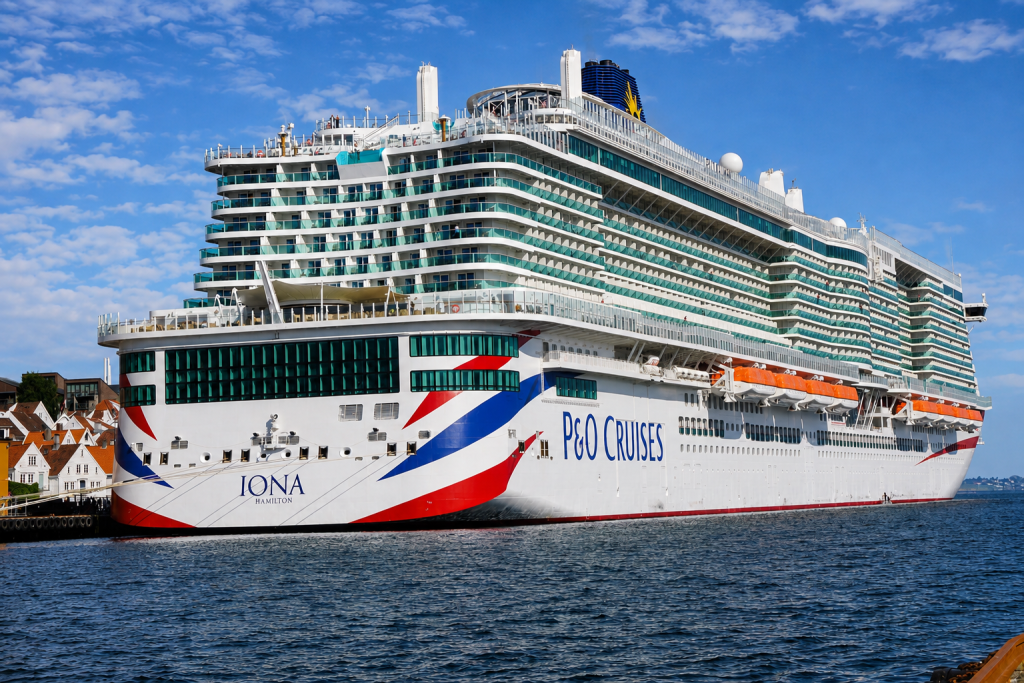
Iona is a leviathan. She is massive.
Our eldest had reservations about ships. She’d heard about a certain vessel beginning with T and ending in itanic, and her imagination was off to the races. Those fears disappeared when she saw Iona up close, dwarfing the surrounding terminal and docks. Was this a ship or some kind of floating luxury town?
Walking into the Grand Atrium, you immediately understand how apt its name is. Grand by name, grand by nature. Like something from The Great Gatsby, it’s all glitz and opulence. Marble-clad stairs spiral through three floors alongside reflective balustrades. It’s easy to forget you’re aboard a ship rather than standing in the foyer of a five-star hotel.
Sitting there with a brew, you can’t help feeling you’ve arrived. This is what holidays are about: a change of scenery, an opportunity to put on your Sunday best and strut around like the proud peacocks we were all meant to be.
Life Aboard Iona
Finding Your Feet
Have I mentioned how big Iona is? I’ll say it again… it’s massive.
It took us a few days to find our feet. I’m not sure we ever did entirely. I take no responsibility for my appalling sense of direction aboard; all the maps are written in pirate speak. Aft, port, starboard… what landlubber understands any of that?
These are things nobody is ever properly taught, yet the knowledge is taken for granted—like reading car number plates. Four days in, I still found myself walking confidently towards my destination only to discover it was at the opposite end or on the other side of the ship. The good news is that there are plenty of maps and signs to confirm you’re going the wrong way.
Eventually, the pirate speak becomes irrelevant because you begin navigating by landmarks instead. The Quays? That’s on Deck 8, right-hand side. The Headliners Theatre? Decks 6 and 7 at the back of the ship. Which way is the Coral Restaurant? From the Grand Atrium, head past Anderson’s, continue beyond the cinema and walk to the end.
Before long, it all starts feeling familiar—a temporary home away from home.
Food & Drink
We’ve established that I’m the living embodiment of a tight northerner. If we haven’t, it will soon become patently obvious.
I’ll therefore focus primarily on the included food and drink options. The MDRs—that’s cruise speak for main dining restaurants: Coral, Aqua, Opal and Pearl—and the buffet were our usual stomping grounds, although I’ll also mention where we paid extra.
The buffet is a standard all-inclusive buffet: no better or worse than you’d find in any number of all-inclusive hotels. That being said, it’s a dessert gold mine. For us, it was usually a post-meal stop to fill a goody bag rather than the destination for a full meal.
Breakfast
Breakfast—the most important meal of the day, apparently. We all know someone who happily skips it. Aboard Iona, that’s a mistake.
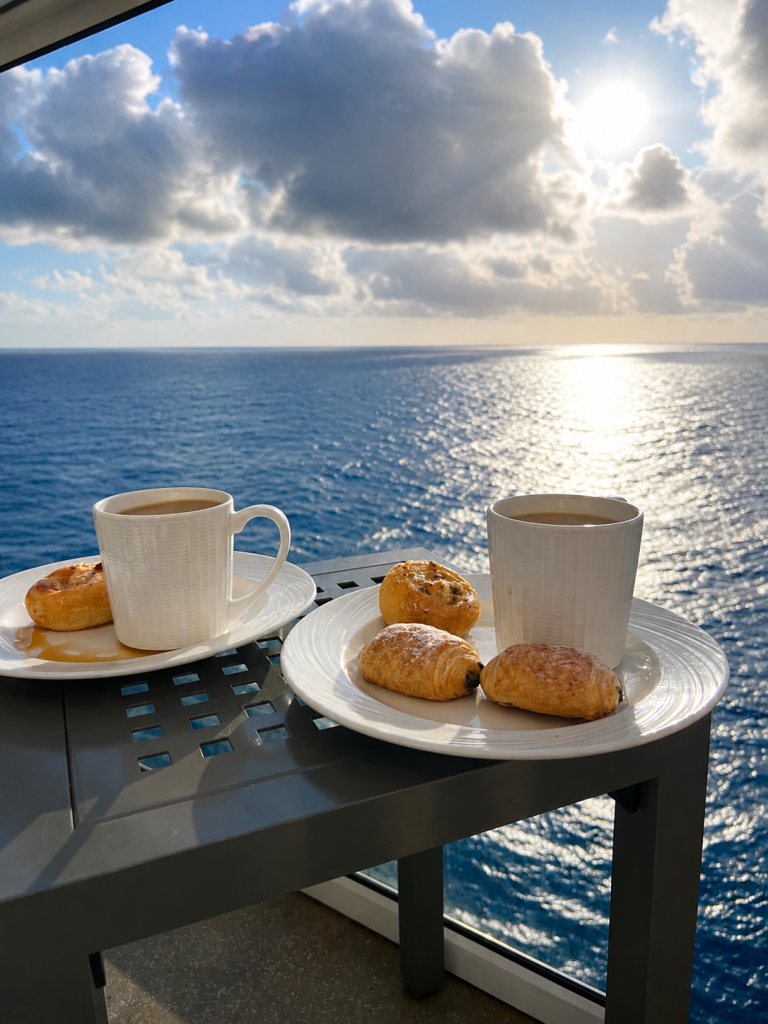
I’ll also include what shall be known as pre-breakfast: coffee and pastries on the balcony. You can collect them from the buffet before retreating to your cabin or order breakfast free through room service. Sipping coffee, nibbling pastries and watching Norway roll past quickly confirms that the balcony was money well spent.
As a bonus, the balcony door is practically soundproof, so there’s no need to whisper for fear of waking the children.
The MDRs quickly became our favourite breakfast destination. Their menus were similar to the buffet, except somebody brought the food to you. No wandering around balancing plates, no hunting for bowls and no deciding whether the final hash brown is worth starting an international incident over. It simply felt calmer.
We pushed the boat out one morning and paid extra for breakfast at the Keel & Cow. Honestly, we didn’t find it any better than the MDRs. Its menu was smaller and, with a fussy eater in tow, we left slightly underwhelmed—before making the inevitable visit to the trusty buffet afterwards.
One final public-service announcement: avoid the porridge. Who makes porridge with water instead of milk? It was more akin to wallpaper paste than breakfast. If it’s fibre you’re after, stick to the Bran Flakes.
If you want speed and flexibility, head to the buffet. If you have an extra half-hour and fancy a slower start, we’d choose one of the MDRs every time.
Lunch
Lunch was probably our family’s favourite meal aboard, and this is where The Quays really shone. It had us returning day after day.
The Quays consists of three food-truck-style outlets—Chippy, Asian and American Diner—alongside a salad bar and the all-important dessert counter. Located just off the Grand Atrium on Deck 8, it was central and easy to find.
The best bit? Mix and match, baby. A little of this, a little of that—all bets are off.
This freedom created the king of all lunches: chippy chips, Southern-fried chicken, chicken gravy and double pudding. We were on holiday, after all. That was Dad and the children sorted; Mum stuck to the healthier Asian prawn stir-fry and salad.
That’s the beauty of The Quays: something for everybody.
Its flexibility and consistency made it our default lunch stop. No compromises, no negotiations and no apologies when your eyes proved bigger than your belly. If we were back aboard tomorrow, we’d be at the front of The Quays queue without a second thought.
It simply got the balance right: quick, varied, relaxed and good enough that we never felt the need to pay extra.
Dinner
Tea—or dinner, if you’re from south of Sheffield—was most often taken in the MDRs. The menu changed each evening, offered something for everybody and even helped us trick our youngest into eating butternut squash, which says more than I ever could.
Booking was straightforward. For an early tea, we reserved a table directly with the restaurant. When eating later after a show, we used the app. Even with around 180 groups ahead of us in the virtual queue, we never waited longer than 30 minutes—just enough time for a quick family card game.
We also tried The Beach House, a South American-style restaurant requiring a supplement, but found the food surprisingly bland.
The Chef’s Table on Celebration Night was considerably better, despite being hosted in part of the buffet. We missed The Olive Grove because we left it too late to book, so reserve any paid-for restaurants that catch your eye well in advance.
Extras & Drinks
Does anybody else have a rule that ice cream is appropriate on holiday, regardless of the time or when you last ate? Yeah, us too.
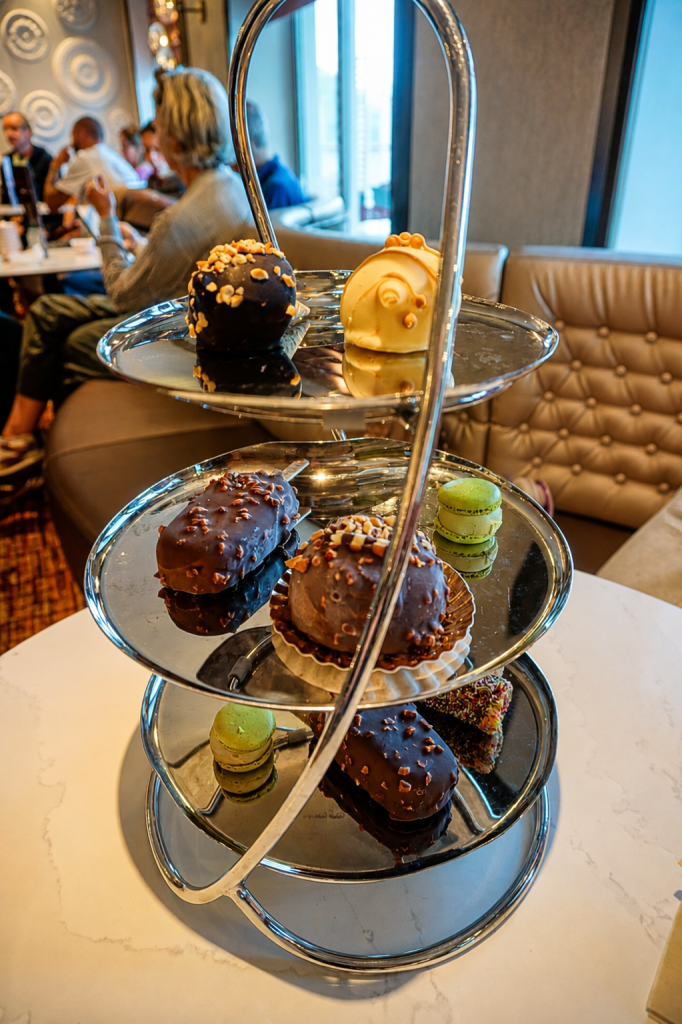
Iona’s answer is Ripples, an ice-cream parlour on Deck 8 where we were excited to try the afternoon tea.
It’s advertised per person. It shouldn’t be.
With all four of us taking part, we ordered afternoon tea for two and added a knickerbocker glory to ensure there would be enough. What arrived was two towers of assorted ice cream—apparently one tower per person—plus the knickerbocker glory.
It was too much, I tell you. A woman at the next table actually gasped when this mountain of ice cream arrived.
I’m not ashamed to admit it defeated us. Learn from our mistake: one afternoon tea would comfortably feed two adults, possibly even two adults and a young child.
The eagle-eyed among you will have noticed that drinks haven’t received much attention. That’s because, as a couple, we aren’t big drinkers. We might have a glass with dinner, but otherwise we don’t really partake.
To retain any hope of controlling the children, we keep them to water and cordial; there are no fizzy drinks in our household.
Our limited experience suggested that drinks were reasonably priced—similar to what you might pay in a fashionable town-centre bar.
A nice touch is that you’re allowed to take two bottles of wine aboard. This gave us a glass on the balcony each evening. Watching the mountains roll past with a glass of wine in hand became a core memory and something I’d recommend to anybody booking a balcony.
Entertainment
Whether it’s organised fun or time at leisure, there’s plenty aboard to keep adults and children occupied.
Top of the bill were the performances from Iona’s resident triple-threat group: they sing, they dance and… well, they sing some more. Their productions were staged in the Headliners Theatre across Decks 6 and 7.
There were three productions during our cruise, of which we caught two: Festival and Digital. We hadn’t booked the third because its description didn’t grab us—a mistake we wouldn’t make again.
Both shows were excellent, with a particular shout-out going to the two female lead singers. Those girls could hold a tune, to say the least.
Our youngest daughter sat entranced for the full 60 minutes, mouth agape. This highlighted one of cruising’s overlooked benefits: it gives younger children an inexpensive introduction to live theatre.
Don’t get me wrong—it isn’t Broadway, but it isn’t Butlins either. We would happily have paid £15 per ticket. A family of four attending all three productions therefore receives the equivalent of around £180 of entertainment within the cruise fare.
Iona also staged a non-bookable acrobatics show in the Grand Atrium. We missed it because there were no seats left. Word to the wise: you’ll need to claim yours around an hour beforehand. Bring some boredom-busters, order a drink and settle in.
The Animal Guyz staged two shows aimed at younger children. These proved invaluable for breaking up the sea days—and gave our eldest some much-needed respite from her younger sister. They weren’t as polished as the theatre productions but remained entertaining and well worth seeing.
The final performance we caught was a gig by Johnny Bourke featuring Irish and rock covers, including two favourites among our daughters: Great Balls of Fire and Tell Me Ma. Watching realisation cross their faces as they recognised the songs was priceless.
Johnny was quite the showman: charismatic and blessed with a great voice. However, he spent almost as long talking as singing, which diminished the show slightly.

Pools & Hot Tubs
When left to our own devices, our leisure time could largely be divided into water-based and non-water-based activities. When it came to the water, it was a tale of two cities.
The main family pool is beneath the Skydome, while infinity pools can be found towards the rear of the ship.
Honestly, the pools were disappointing. Given Iona’s size and the number of passengers aboard, they seemed absurdly small. Once 10–15 people entered one, it felt cramped, with little room to play or properly enjoy yourself.
If you’ve imagined starting the day with a morning swim before breakfast, I’m sorry to deliver the bad news: no sooner have you pushed away from one end than you’ll need to tumble-turn and come back.
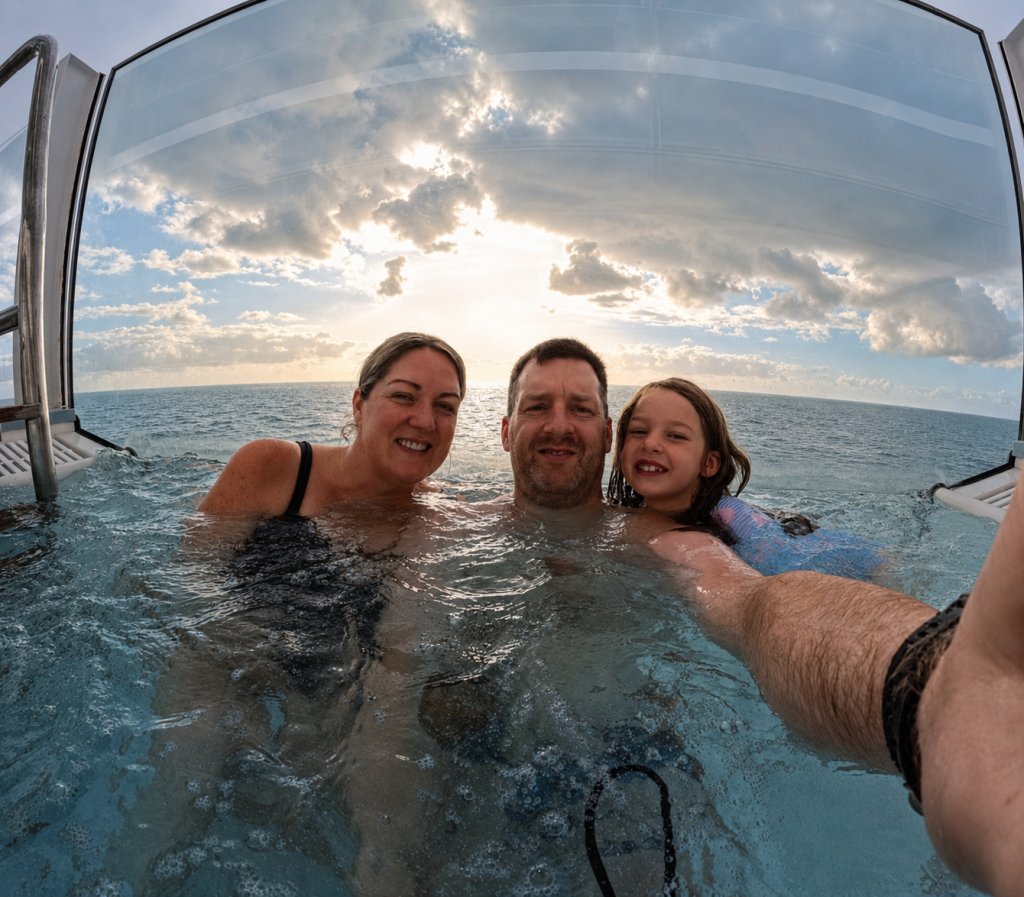
The hot tubs, on the other hand, were a genuine positive. Dotted around the Lido Deck, Skydome and rear of the ship, they were generally open from 8am until 8pm.
Although arguably still too few for the number of passengers, we managed to secure one whenever we wanted. Perhaps we simply loitered with intent and made people uncomfortable. More likely, choosing the Lido Deck rather than the Skydome improved our chances.
Deck Games & Duck Hunts
Non-water-based entertainment primarily involved the two Ds: deck games and duck hunts.
The deck games consisted of several shuffleboard lanes, two quoits lanes and two table-tennis tables. We’d never heard of quoits either—and still aren’t certain how to pronounce it—but signs explain the rules, so there’s no need to study beforehand.
Never a family to turn down some friendly competition, these provided the perfect venue for the family Olympics.
The duck hunts were an unexpected bonus. Apparently, hiding little ducks around the ship for other passengers to discover is a cruise tradition. We’d read about it before leaving but hadn’t thought much of it.
I say “apparently.” It is absolutely a thing.
I became more invested in finding them than any self-respecting adult should.
Fair warning: the ducks are as rare as worms in top hats. We expected to encounter them at every turn. Not so. I think that rarity is precisely what makes hunting for them such an effective way to pass an hour while getting your steps in.
It appeals to that place in all of us that wants the thing we can’t have—the forbidden fruit…
…which, in this case, is a 2p duck ordered from Shein.
Go figure.
Unfortunately, because we’d almost dismissed the tradition before boarding, we hadn’t brought any ducks to hide ourselves. That was a mistake. It would have given the children another activity during their downtime, and they would have enjoyed hiding them just as much as finding them.
Shopping on Board
Shopping aboard largely replicates the duty-free experience you’d find at any UK airport. However, there is one standout I want to draw your attention to—the Photo Hub—but I’m getting ahead of myself.
The Avenue Shopping
Let’s begin with what the deck map calls The Avenue Shopping.
It contains all the usual duty-free favourites: somewhere for discounted alcohol, somewhere for perfume and beauty products, and somewhere selling overpriced charging cables because they know they have you over a barrel.
Can you tell I paid £25 for a USB charger?
There are also several luxury-goods shops selling everything from Mulberry bags to Breitling watches. As a tight Yorkshireman, I quickly scooted past them.
Our eldest bought a charm from the Pandora shop. Unfortunately, she didn’t take advantage of the 20% discount offered on the first sea day. The deal was never repeated, so that decision cost us an extra £10.
Another shop sells what I’ll affectionately call local tourist tat—everything you’d expect to find in a standard souvenir shop. There’s no judgement here; I am myself the proud owner of a Norwegian troll.
There is also a confectionery shop, but I won’t dignify it with anything more than this:
£5 for a bag of popcorn should be illegal.
The Photo Hub
Now that’s out of the way, let’s discuss the shop I genuinely liked: the Photo Hub.
To demonstrate quite how much we liked it, we spent £135 of our £550 spending budget there. That’s almost a quarter of the entire budget.
I have absolutely no idea whether the photographs are competitively priced. Professional photography isn’t something I have much cause to compare in everyday life. What I can say is that, for us, the finished products were worth every penny.
We came away with two photographs.
The first was a family portrait taken on Celebration Night: the girls looking beautiful in their posh frocks and me trying not to resemble a string of sausages squeezed into my suit.
That photograph made us appreciate how quickly the girls have grown. It’s sometimes difficult to notice when you’re with them every day, but the picture forced us to stop and really look at them.
Somewhere along the way, without us properly noticing, our little girls had grown up.
It captured a moment in time that we’ll never get back.
It cost £25.
The Photo Hub also provides the unusual opportunity to have your iris photographed.
I’m not ashamed to admit that, as soon as I saw it, I wanted one—and had almost decided I’d pay whatever ridiculous price they asked.
We chose a family portrait of sorts: one image containing all four of our irises.
The mathematically gifted among you will already have realised that this was not a cheap photograph. We spent £110 for one print and a digital copy.
Yes.
£110.
For a photograph of our eyeballs.
I know that isn’t cheap. For us, however, it created a unique family memento that we’ll discuss for years. It already has pride of place at home and will undoubtedly become a talking point whenever guests visit.
Whether four photographed eyeballs are worth the nauseating price is entirely subjective—but we don’t regret it.
So yes, apparently I draw the line at a £5 bag of popcorn but will happily spend £110 on a picture of four eyeballs.
Tight Yorkshireman economics.
The Ports
As mentioned earlier, we split the ports down the middle: two full-on activity ports and two leisure ports without excursions or a fixed itinerary.
This was partly to conserve money—excursions can be expensive—but also to preserve Mum and Dad’s sanity. Previous holidays have taught us that too much go, go, go tires the children out, which inevitably leads to tantrums, which inevitably causes arguments, which inevitably ends with Dad calling the children ungrateful.
No fun for anybody concerned.
Stavanger and Haugesund were our leisure ports, while Olden and Hellesylt were reserved for activities.
Stavanger
Stavanger was our first taste of Norway and a great port in which to ease ourselves into the trip.
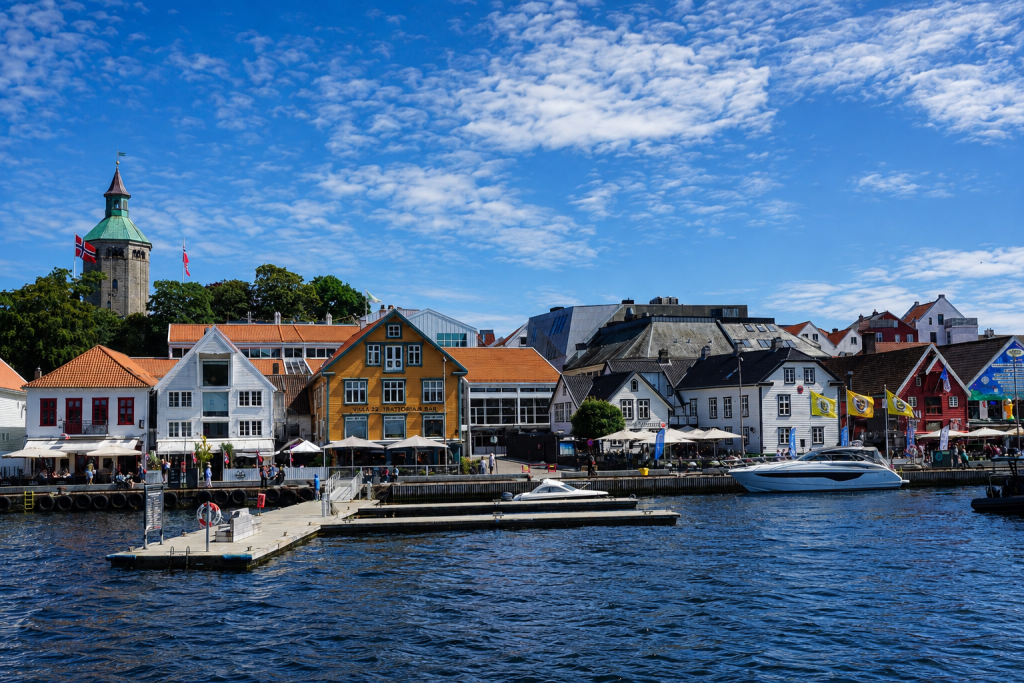
We’re a family that loves a bargain and therefore enjoys diving into charity and second-hand shops, rooting around for whatever treasures we can find.
That was largely our Stavanger plan: wander around town, browse the shops and stuff our faces with as much pastry as possible. We had a vague intention to walk through Gamle Stavanger and visit the Colourful Street, but otherwise the day remained fluid.
Our first stop, directly beside the ship, was Gamle Stavanger. You could practically throw a stone from Iona and hit it.
Gamle Stavanger is essentially the old town, filled with picturesque wooden houses built in a traditional Norwegian style and painted white.
Our visit was brief. The area was very pretty and surprisingly peaceful given its proximity to the port. However, there wasn’t a right lot happening to retain the children’s attention.
To quote our eldest: “Seen one house, you’ve seen them all.”
Such a philistine.
We took the obligatory holiday photographs for the scrapbook and headed back towards the port.
From there, we walked to the Colourful Street—or Fargegaten on Øvre Holmegate, if you’re fluent in Norwegian.
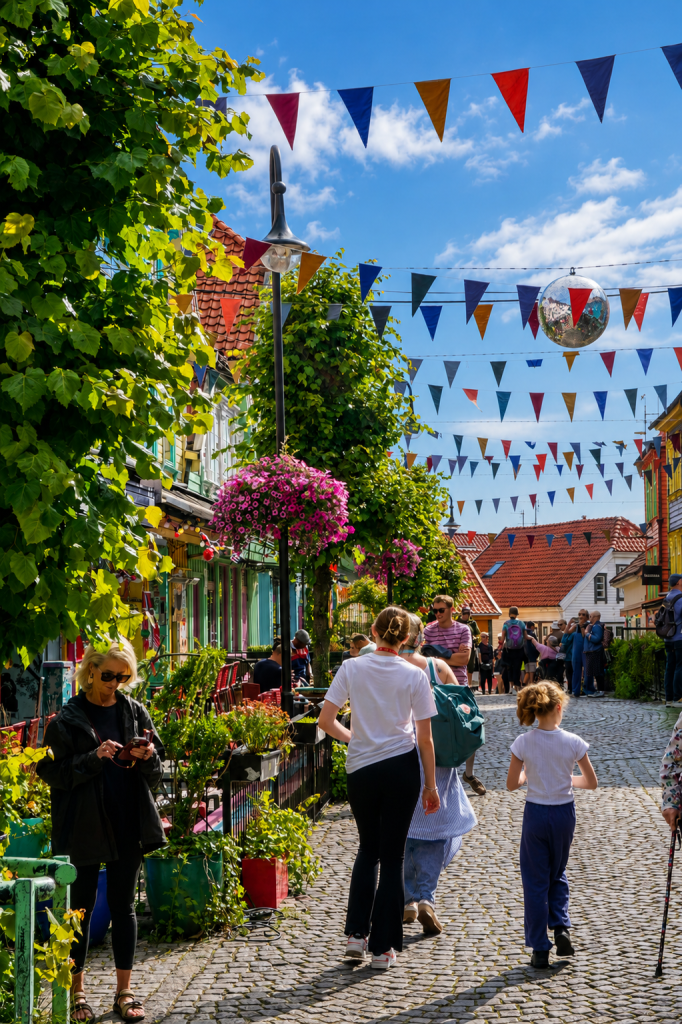
It’s the direct opposite of Gamle Stavanger. As you’ve probably guessed from its name, it’s a kaleidoscope of colour, with every building painted differently and creating a vibrant, bohemian atmosphere.
The buildings contain bars, cafés and independent shops. We took the opportunity to visit Bøker og Børst for our first taste of Norway’s famous cinnamon buns.
As good as the buns were, the hot and iced chocolates won the day. I have it on good authority from the children that these alone justify the visit. Imagine enough chocolate, cream and marshmallows to make every parent sigh, knowing they’ll pay for all that sugar later.

From there, we simply meandered along whichever streets appeared to contain shops. Sorry I can’t be more specific—we genuinely wandered without any particular direction in mind.
Since I can’t tell you precisely where we were, I’ll tell you about Stavanger’s second-hand shops instead.
Norway doesn’t do second-hand shops in quite the same way as the UK. Forget the British Heart Foundation or Oxfam store in every forgotten shopping precinct. These shops were on another level: trendy, stylish and modern.
The quality was particularly high. Everything had clearly been cared for and remained in good condition.
We visited three: THRIFT, UFF Second Hand and Fretex. We didn’t buy anything because nothing particularly jumped out at us, but we were glad we’d looked.
One place where we did spend money was the local supermarket, in this case Extra Klubbgata.
One of our favourite holiday activities is sampling local chocolate and confectionery. We grab as much as we can carry, arrange a tasting menu back at our accommodation, put on a film, stuff our faces and critique everything as though we’re judges on MasterChef.
The girls, Mum and Dad each chose one drink, one packet of crisps and one chocolate bar. We ended up with nine items for just under £30, which wasn’t too bad considering the horror stories about Norway’s prices.
Let’s get Kvikk Lunsj out of the way first. I understand that it’s culturally significant in Norway, but… it’s essentially a KitKat.
I don’t want to appear culturally insensitive, but when did anybody last become excited about a KitKat? That isn’t to say we didn’t eat it, but set your expectations accordingly.
The best chocolate proved divisive. The adults favoured the hazelnut Freia Melkesjokolade, while the children inexplicably preferred some god-awful Bamsemums bear things. I couldn’t tell you what the filling was, except that it was bad.
Clearly, Norwegian children and my children know something I don’t.
Another activity we always seem to stumble into is eating at the local version of Greggs. This isn’t a conscious effort; it simply happens as a happy accident. Everywhere appears to have its own pastry fast-food chain, and they rarely disappoint. It isn’t cordon bleu cuisine, but it’s useful in a pinch.
Norway’s answer is Backstube—conveniently opposite the supermarket—and it didn’t disappoint, provided expectations remained sensible. The service was quick, the food was tasty and the prices were reasonable. We each collected either a pastry or sandwich to eat while walking back towards the ship.
We thoroughly enjoyed pottering around Stavanger. With hindsight, it had the most cosmopolitan atmosphere of all four ports. It offered noticeably more shops, cafés and bars and felt like somewhere you could happily explore without needing a detailed plan.
If you want a holiday souvenir—Norwegian troll, anybody?—buy it in Stavanger.
We decided to wait because it was our first port and assumed there would be plenty more opportunities. As it turned out, none of the others offered nearly the same variety.
Lesson learned: when you see a three-headed Norwegian troll, buy the three-headed Norwegian troll.
No, it won’t necessarily be available in every other port.
Olden
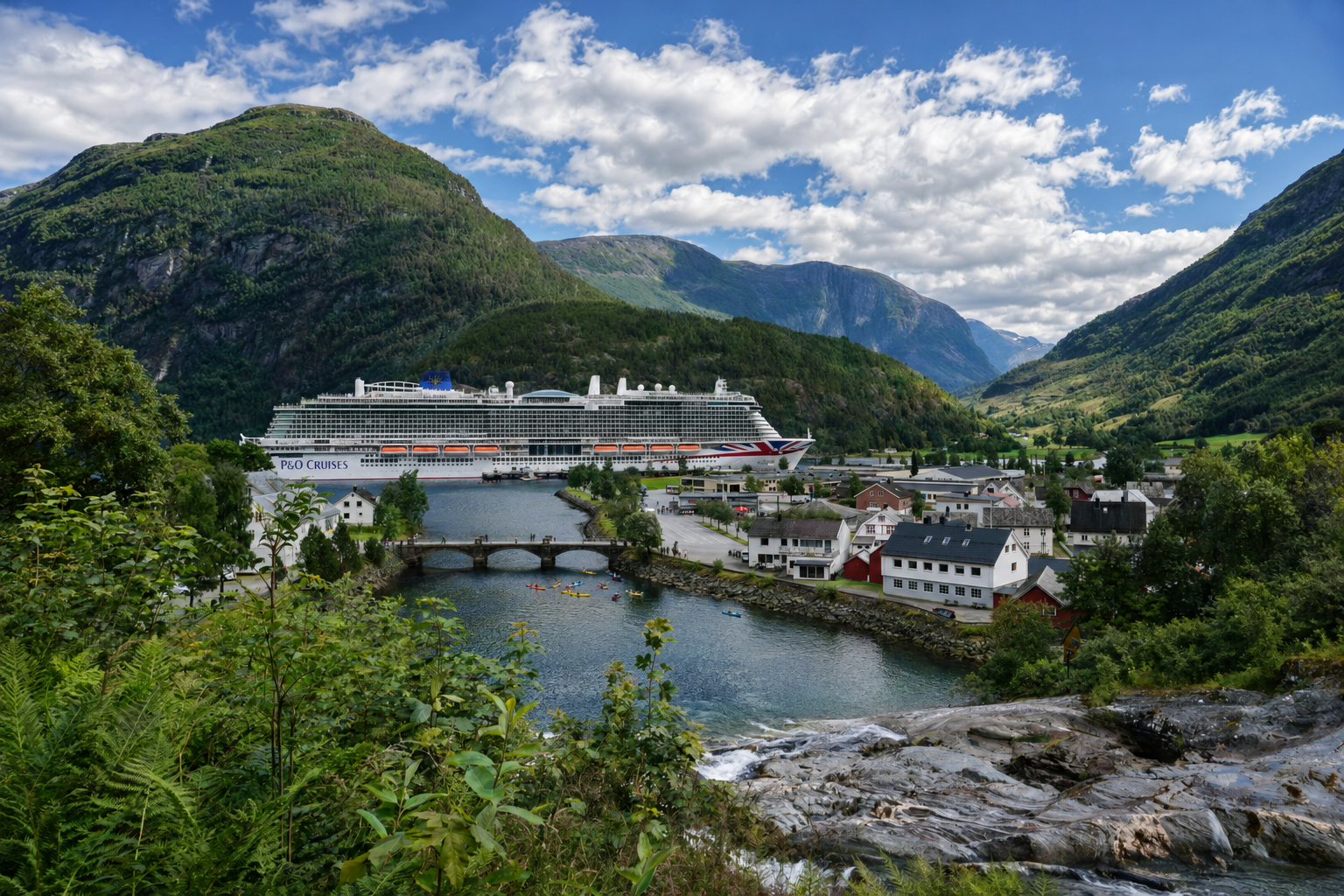
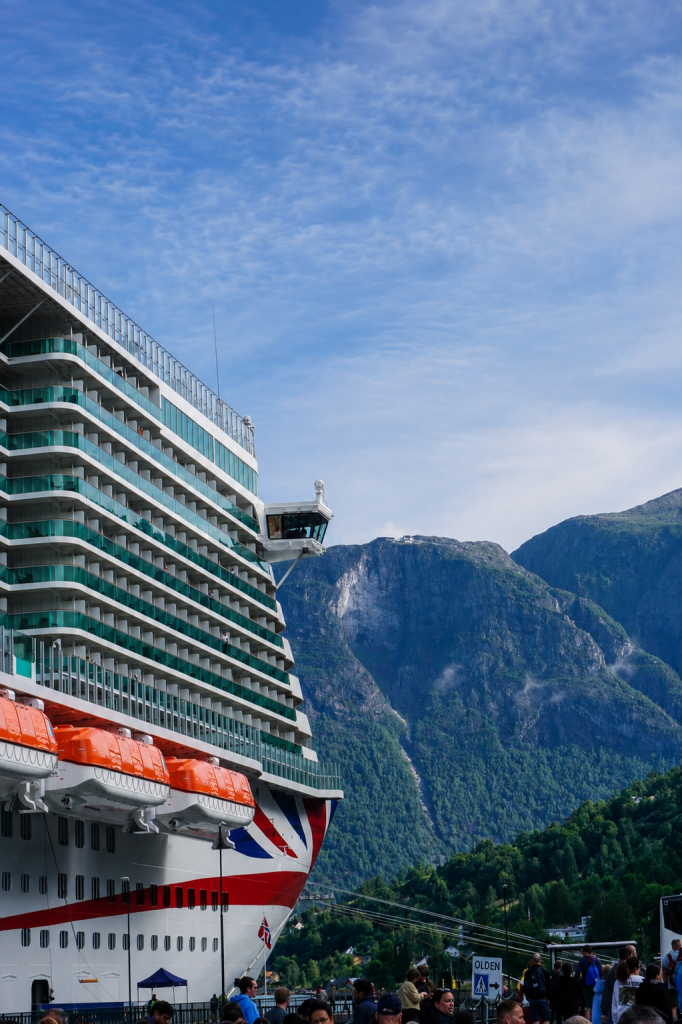
Olden gives you your first proper taste of the Norwegian fjords in all their dramatic majesty.
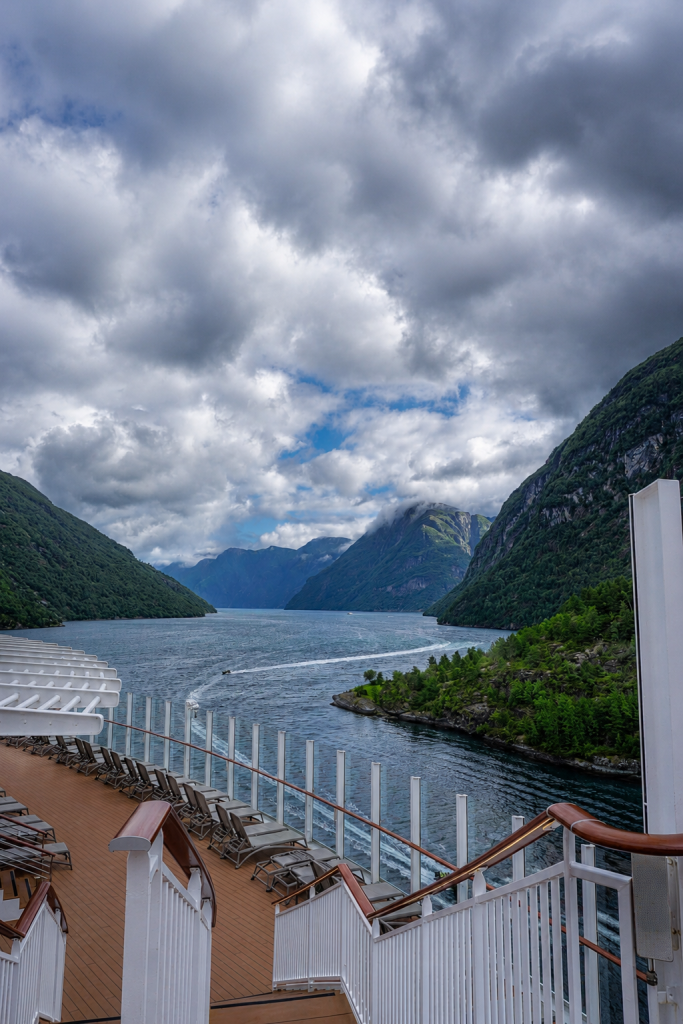
The sail into Stavanger is pretty; the sail into Olden is breathtaking. This is where the extra cost of a balcony repays you tenfold. Do yourself a favour: get up early, grab a brew and a blanket, and watch the fjord roll past.
You’ll be rewarded with some of the most stunning scenery of the entire cruise—and yes, I’m already running out of adjectives.
Olden was one of our activity-driven ports. We’d booked a Troll Car tour to Briksdal Glacier, followed by the Loen Skylift to the summit of Mount Hoven.
We booked both through Olden Adventures, which provided transfers from the port and—most importantly to this tight Yorkshireman—charged considerably less than P&O.
Olden itself is tiny. As far as we could tell, it consisted of a pub, two souvenir shops and not much else. We didn’t leave ourselves time to explore it because we’d made our first planning mistake of the cruise: trying to cram in both headline attractions.
Briksdal Glacier
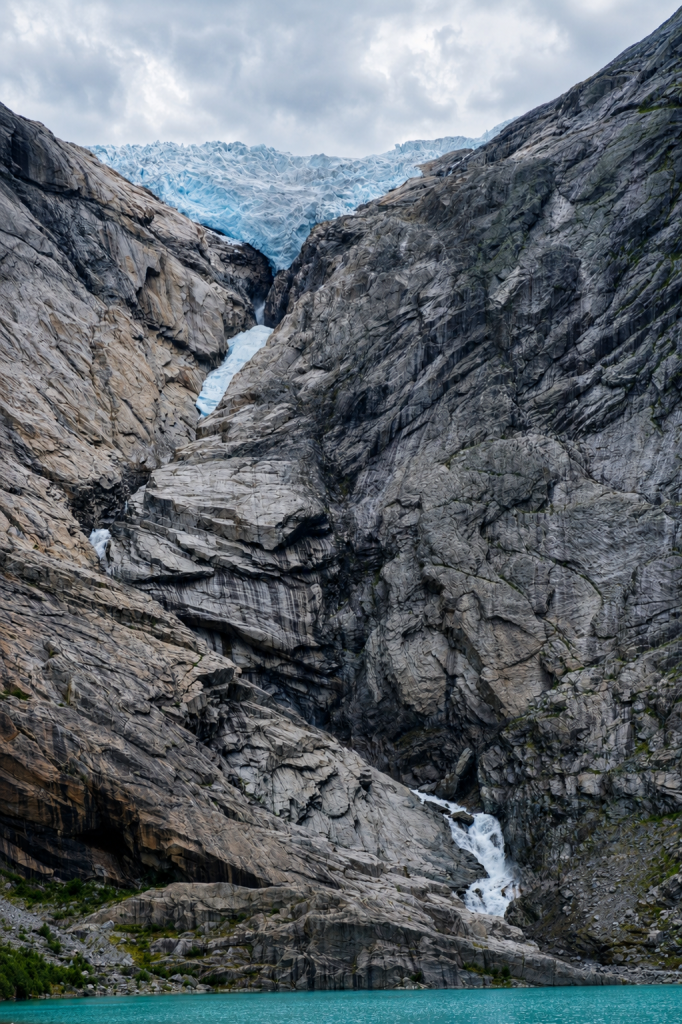
First up was Briksdal Glacier. We boarded a coach at the port for a 40-minute journey through the valley, following a crystal-blue river until it joined an enormous lake.
The drive is almost an attraction in itself.
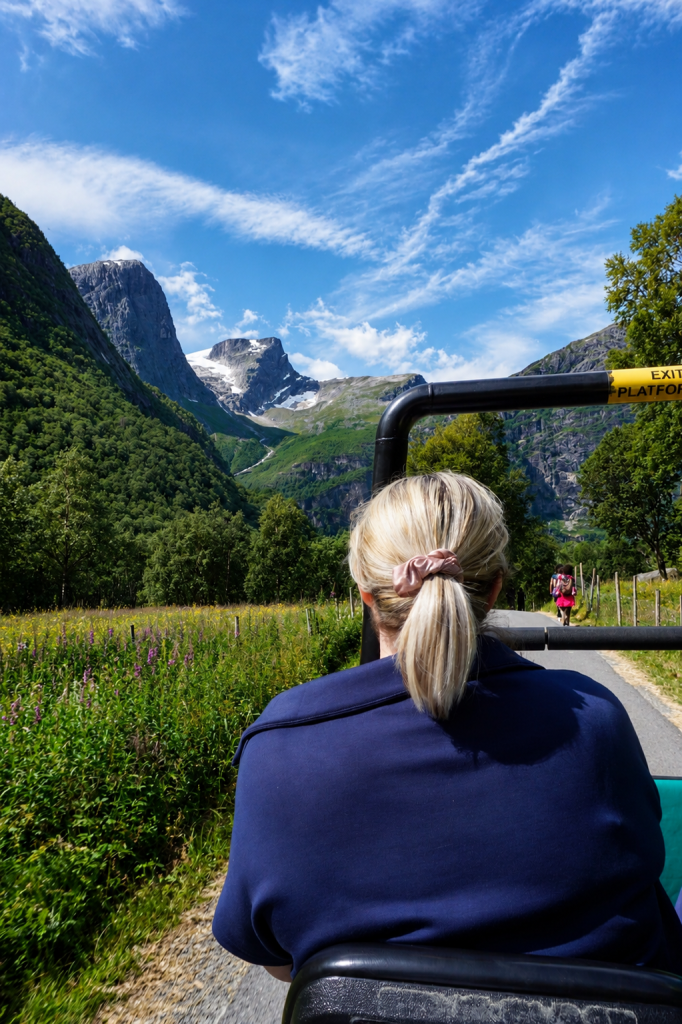
From the visitor centre, you can either walk or take a Troll Car towards the glacier. The walk takes around 45 minutes and is described as easy, although I think that description is slightly misleading. Several steep uphill sections require a reasonable level of fitness.
It’s hardly Everest, but I’m glad we didn’t attempt it with the children. We would either have given up or missed the ship.
If you plan to use the Troll Cars, book in advance. When we arrived, they were fully booked until 17:00. Turning up and deciding whether to walk could therefore leave the decision firmly out of your hands.
The Troll Car journey takes around 15 minutes, passing waterfalls with jaw-dropping scenery on every side.
Each car carries seven passengers—two rows of three and one person beside the driver—so larger groups may be split. Even a group of four paired with a group of three could find one person seated separately at the front.
From the drop-off point, it’s another 15-minute walk along an undulating trail to reach the glacier.
Unfortunately, our tour allowed only around 15 minutes there before we had to begin walking back. Between the crowds and constantly checking the time, we never had a proper opportunity to appreciate it.
The glacier itself did not disappoint. It looked like something from The Lord of the Rings: a crystal lake flanked by stark mountains, with the glacier standing watch between them.
It’s the kind of place that makes you stop, think and gain a little perspective on life.
In total, the excursion took around three and a half hours, of which approximately 15 minutes were spent at the glacier. It was undeniably beautiful, but we’d choose a more flexible option if we visited again.
Loen Skylift
From coach to shuttle bus, we were off to the Loen Skylift.
Olden Adventures operates regular transfers from the cruise terminal, but the buses become packed and you may wait around 40 minutes if you don’t make the first one. The journey itself takes only ten minutes.
We arrived at the Skylift between 13:00 and 13:30 and joined another queue—this time for around 75 minutes.
Each cabin carries 35 passengers and takes approximately seven minutes to reach the summit. There are only two folding seats inside; everybody else stands. Bear that in mind if mobility is a concern.
The cabins depart regularly, somehow tricking you into not realising quite how long you’ve been waiting.
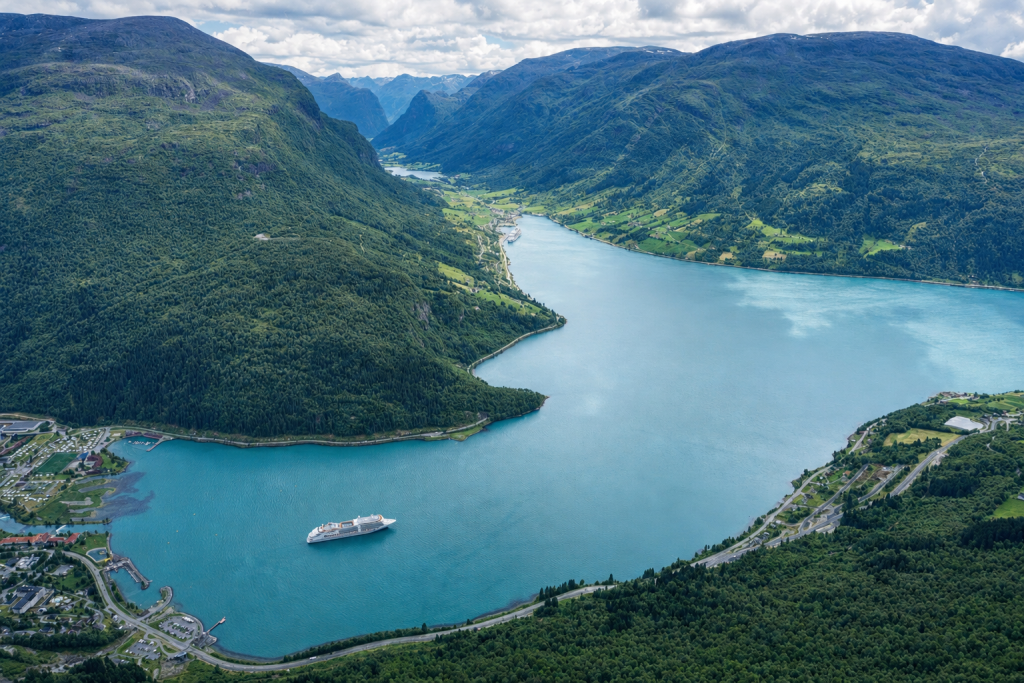
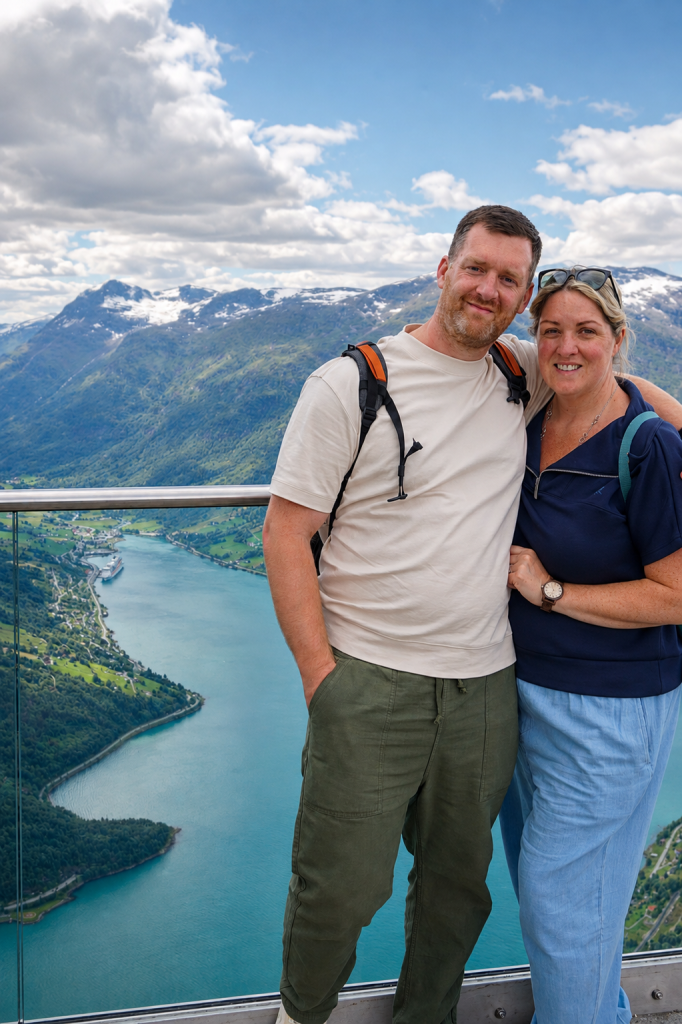
The journey up is staggering. You’re whisked towards the heavens surprisingly quickly as unrivalled views unfold beneath you. I lost the competition to be the first to spot Iona, much to my daughters’ delight.
Words can’t do the summit justice… so I won’t even try.
You feel like a Norse god looking down on creation. Of all the spectacular scenery we encountered during the cruise—and there was plenty—Mount Hoven took the gold medal.
The views may be the jewel in its crown, but there is much more to do at the summit. Adrenaline junkies can tackle the zipline or via ferrata, while those with a more conservative constitution can explore the walking routes or eat in the restaurant overlooking the fjord.
Unfortunately, we’d left ourselves only enough time to admire the view before joining the queue back down.
I’m going to write something that sounds bloody obvious, but it genuinely hadn’t occurred to us: that 75-minute queue going up? Yeah, you may face the same thing coming back down.
We hadn’t accounted for that until we reached the summit and saw the return queue.
Between that and waiting for another shuttle, our eldest became convinced we would miss the ship. We eventually made it back with 30 minutes to spare—far too close for our conservative constitutions.
Iona ultimately departed an hour late because another tour had been delayed, but that isn’t something worth gambling on.
Final Thoughts on Olden
Let’s discuss the famous Olden sail-away.
Online accounts conjure images of locals lining the port, waving and cheering as though you’re departing royalty.
Our experience was rather more subdued.
The pub played soft rock, one family danced and waved flags, and a shopkeeper half-heartedly waved hers while scrolling through her phone.
That was about it.
Perhaps we caught it on an off day, but we certainly wouldn’t miss a dinner reservation to watch it again.
I’m going to say it: we got Olden wrong.
We tried to do too much and ended up short-changing ourselves on both excursions.
Given another opportunity, we’d devote the entire day to the Loen Skylift and Mount Hoven. Briksdal Glacier was impressive, but for us it couldn’t match the awe-inspiring scale of the views from the summit.
We’d book a meal in the restaurant overlooking the fjord, explore the walking routes and properly experience everything Mount Hoven has to offer.
Hellesylt
Ah, Hellesylt. You beautiful little enigma.
Before the cruise, Mum had spotted a high-speed RIB ride through the fjord and immediately decided we should do it. Dad saw that it would cost nearly £200 for the four of us and immediately decided we shouldn’t. Several conversations later—and through a combination of persistence, persuasion and wearing him down—Mum won.
Even our eldest wasn’t convinced. Boats, cold water and high speeds didn’t sound like her idea of fun. As it turned out, she wasn’t the only one who would be surprised by just how good it was.
The RIB Ride
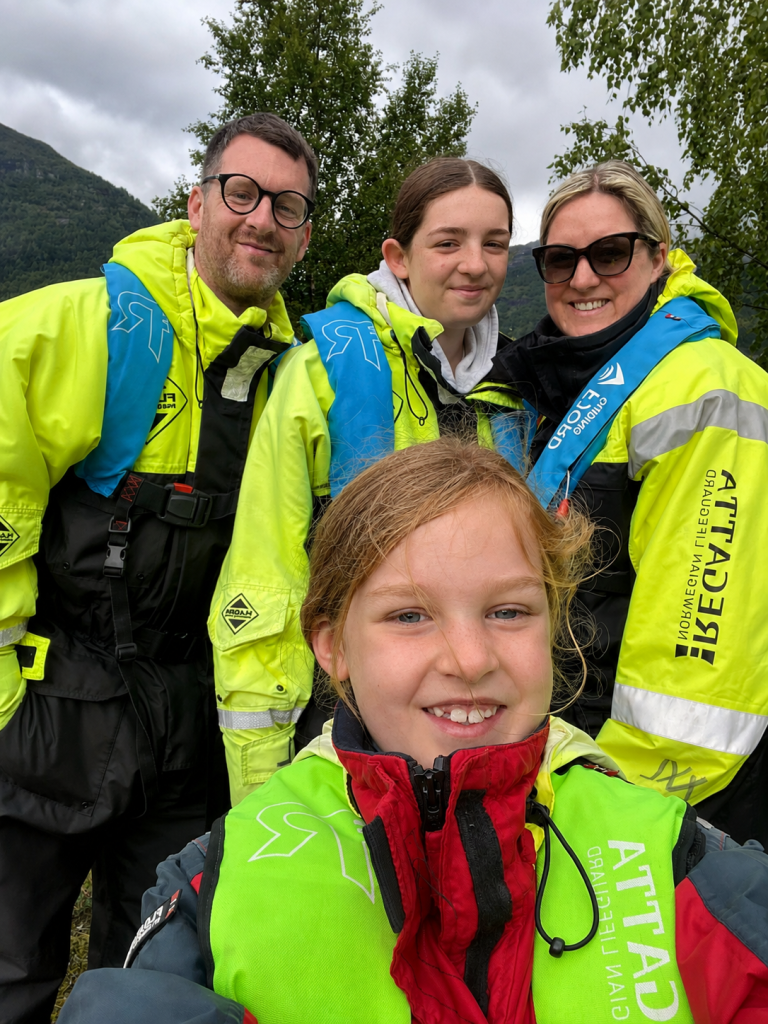
We were fitted with waterproof overalls and life jackets before being led down to the RIB. The girls sat in the front row, with our eldest looking increasingly unsure about the entire arrangement.
Within about two minutes of setting off, she was completely converted.
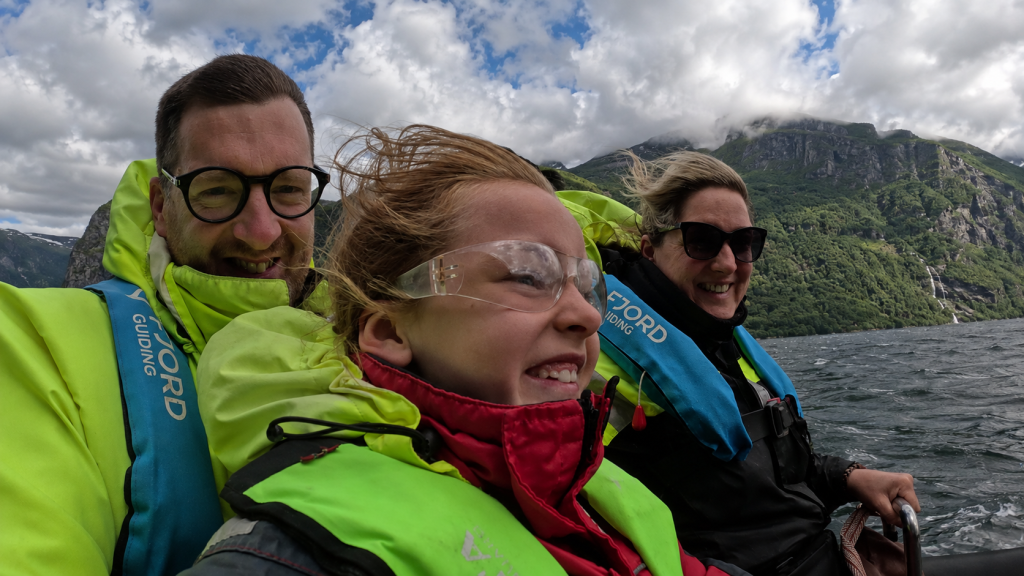
The RIB sped out into the fjord and took us into places that a ship the size of Iona could never reach. We passed waterfalls, remote farms and mountains that seemed far more imposing from water level. Seeing the landscape from such a small boat made the scale of everything around us feel enormous.
It was fast, cold and occasionally bumpy—and we loved every minute of it. The excursion we had debated most became one of the clearest highlights of the holiday. It wasn’t cheap, but it delivered exactly what we wanted from Norway: an experience the four of us would remember long after returning home.
Back on dry land, we returned to Iona for lunch and some deck games before heading out again for a rather colder encounter with the fjord.
Wild Swimming at the Badehus
Mum enjoys outdoor swimming, so she had already decided that she couldn’t visit a Norwegian fjord without getting into one. The rest of us approached the idea with varying degrees of enthusiasm.
The Badehaus is around a five-minute walk from the cruise terminal. There’s a wooden pier and diving tower, changing facilities, a grassy area and a small beach. The entrance was slightly seaweedy when we visited, so water shoes would have been useful, although they weren’t essential.
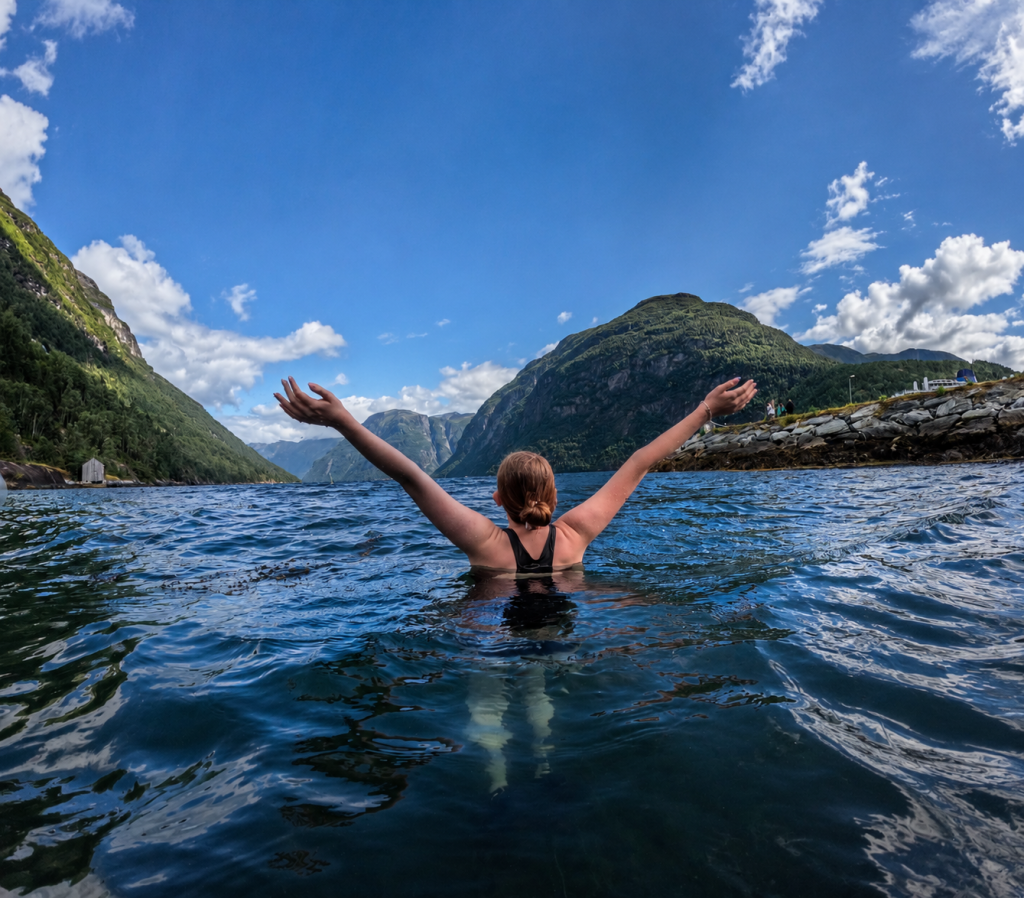
The water was Baltic. There was an initial period of sharp breathing, involuntary noises and questioning every decision that had brought us there. After five or ten minutes, however, the shock began to fade and we could properly appreciate where we were swimming.
Our eldest became the first of the children to fully submerge herself, while our youngest sensibly remained around waist depth and paddled. Surrounded by mountains and waterfalls, it was difficult to imagine a more spectacular swimming pool.
Hellesylt deserves more credit than it sometimes receives. It’s a small place—a church, a petrol station, a shop and the waterfall most visitors stop to photograph—but it has bags of heart. Between the RIB ride and swimming in the fjord, we returned to the ship grinning like Cheshire cats.
It may not have had the biggest attraction or the most famous viewpoint of the cruise, but Hellesylt gave us the most fun. Look beyond the waterfall and give it the time it deserves.
Haugesund
Haugesund was our final port, and after three busy days we deliberately planned to take things slowly. We had enjoyed wandering around Stavanger without much of a plan, so we assumed the same approach would work here.
That was a mistake.
The walk into town took around 20 minutes across the Risøy Bridge and was fairly uneventful. We had also arrived before many of the shops opened—some didn’t open until 10 or 11—so there was little reason to rush off the ship.
Haraldsgata, the main shopping street, had plenty of souvenir shops, but many felt repetitive and we didn’t find the same character or quality we had enjoyed in Stavanger. We joined the queue at Cupcakehuset after seeing it recommended elsewhere, waited around 25 minutes and eventually emerged with perfectly nice cupcakes that didn’t quite justify the ceremony.
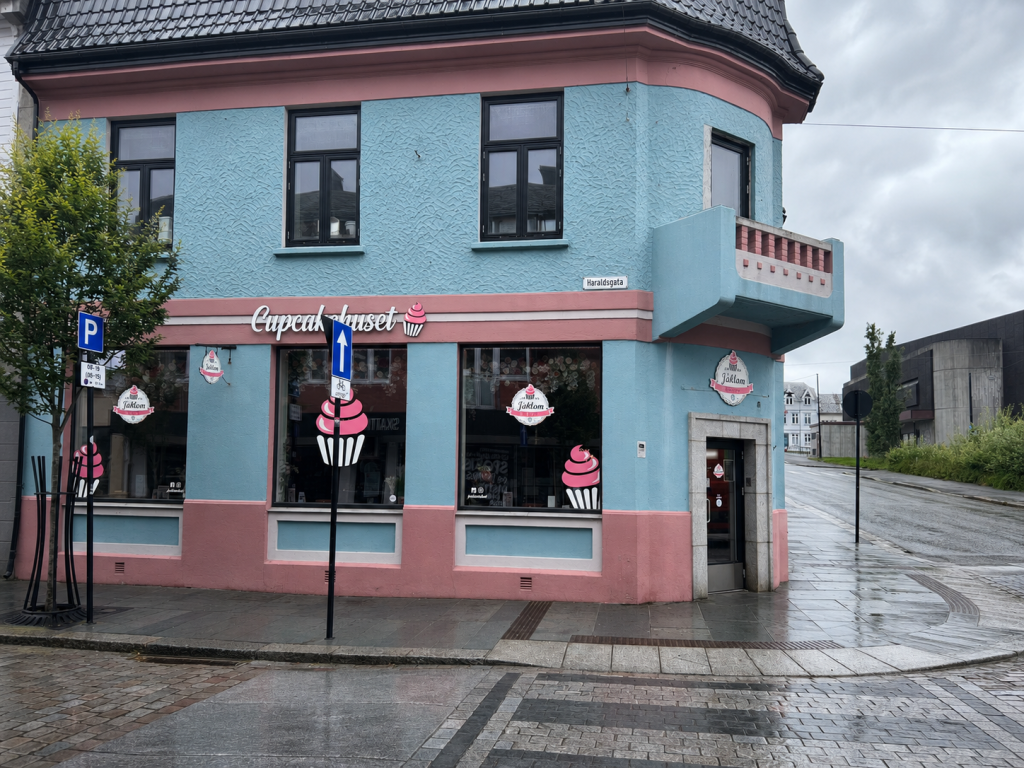
By early afternoon, we had returned to Iona. After the scenery and experiences of Olden and Hellesylt, Haugesund felt like an anticlimax.
That may say more about our lack of planning than the destination itself. With hindsight, we would have visited the Viking farm at Avaldsnes or followed the coastal path towards the Rising Tide horse sculptures. Both would have given the day more purpose and shown us something beyond the town centre.
Our advice for Haugesund is simple: have a plan. It probably isn’t the best port for stepping ashore and hoping the day will work itself out.
Our Favourite Port
Hellesylt was the surprise of the cruise and, ultimately, our favourite port.
It didn’t have Olden’s famous attractions or Stavanger’s attractive old town. What it gave us was the most enjoyable day we spent together: racing through the fjord on a RIB, swimming in freezing water and laughing about both afterwards.
That was a useful reminder that the “best” destination isn’t necessarily the one with the biggest landmark or most dramatic viewpoint. Holidays are about the moments you share and the memories you bring home—and Hellesylt gave us more of those than anywhere else.
What We Got Wrong
For all the planning we did, we didn’t get everything right. Some mistakes cost us time, some cost us opportunities and at least one involved an unreasonable quantity of ice cream.
Here are the things we would change if we did the same cruise again.
1. Trying to Do Too Much in Olden
Booking both Briksdal Glacier and the Loen Skylift sounded efficient. In reality, it made the day feel rushed and left too little time to properly enjoy either experience.
Both were worth visiting, but we would choose one next time and give it the time it deserved. Trying to squeeze every major attraction into a single port day doesn’t necessarily make the day better.
2. Arriving in Haugesund Without a Plan
Our relaxed approach had worked well in Stavanger, so we assumed it would work everywhere. Haugesund proved otherwise.
If we returned, we would book the Viking farm at Avaldsnes or plan a walk along the coast towards the Rising Tide sculptures. Some ports reward aimless wandering; others are much better when you know what you’re going to see.
3. Not Booking Early Enough
We underestimated how quickly some restaurants and shows would fill up. By the time we tried to book certain performances, the most convenient times had disappeared, and we missed out on eating at The Olive Grove altogether.
The lesson is simple: once bookings open, reserve anything you would be genuinely disappointed to miss. You can always change your plans later, but you can’t book a table or seat that is no longer available.
4. Not Bringing Ducks
We hadn’t realised how popular hiding rubber ducks was on cruise ships until the girls began finding them around Iona.
They loved the unexpected treasure hunt, and we immediately regretted not bringing some of our own to hide. It’s a small and inexpensive addition, but one that would have given them another activity to enjoy throughout the week.
5. Death by Ice Cream
Ripples served excellent ice cream, and we approached this information with insufficient restraint.
The same warning applies to afternoon tea: one portion can comfortably feed two or three people. Cruises make it very easy to treat every available meal as a personal challenge. Pace yourself—or at least accept the consequences.
What Did Our Iona Cruise Cost
Cruise prices rarely tell the whole story. Our fare covered the balcony cabin, food in the main dining venues, entertainment and coach travel to Southampton, but excursions, spending on board and purchases ashore increased the final cost considerably.
Here is exactly what our seven-night Norwegian Fjords cruise cost for a family of four.
| Cost | Amount |
| Cruise fare, including coach travel | £4,296.00 |
| Excursions | £650.36 |
| Spending on board | £378.65 |
| Spending ashore | £250.05 |
| Travel insurance | £86.02 |
| Total before onboard credit | £5,661.08 |
| Onboard credit | −£110.00 |
| Actual total cost | £5,551.08 |
Excursion Costs
Excursions were our largest additional expense, costing £650.36 in total:
• Briksdal Glacier Troll Car: £251.09
• Loen Skylift: £203.27
• Hellesylt RIB ride: £196.00
We could have spent less by exploring independently, but these were also responsible for several of our strongest memories from the cruise. The mistake wasn’t paying for experiences—it was trying to fit too many of them into Olden.
Spending on Board
Our onboard account came to £378.65, although £110 of onboard credit reduced the amount we actually paid.
The largest purchase was £135 at the Photo Hub. That included a £25 portrait from Celebration Night and a £110 Iris family print with a digital copy. We spent around another £50 on souvenirs and a replacement charger, leaving £83.65 for smaller purchases such as drinks and ice cream.
Was it Worth the Money?
Our additional spending came to £1,255.08 after onboard credit—around 29% on top of the original cruise fare. That is worth remembering when comparing the advertised price of a cruise with what the holiday is likely to cost in practice.
Plenty of the extras were optional, and a family determined to keep costs down could spend considerably less. For us, the excursions were worth prioritising because the experiences were the main reason we had travelled to Norway.
Put simply, it cost us £4,296 to be allowed on the ship. We then spent another £1,255.08 turning it into a holiday.
Tips for First-Time Cruisers on Iona
We boarded Iona as complete cruise novices and left with a much better understanding of how to make the most of the experience. These are the things we wish we had known before sailing.
- Don’t assume you need speciality dining. The food in the main dining rooms was consistently good, and it was entirely possible to eat well without paying extra. Treat speciality restaurants as an optional experience rather than a necessity.
- Book important shows and restaurants early. Popular performances and dining times disappear quickly. If there is something you would be disappointed to miss, reserve it as soon as bookings open.
- Don’t try to do everything. Iona has more activities, venues and entertainment than you can realistically fit into one week. Choose what matters to your family and accept that you will miss things.
- Make time for the sail-ins. Arriving in the Norwegian fjords was part of the experience, not simply the journey between ports. Set an early alarm, make a drink and watch from your balcony or an open deck.
- Bring rubber ducks to hide. Children search for hidden ducks around the ship, often with labels showing where they have travelled from. Our girls loved finding them, and we wished we had brought some to join in.
- Pack magnetic hooks. Cabin walls are magnetic, so hooks provide useful extra storage for coats, bags, lanyards and other items that otherwise end up covering every available surface.
- Remember that most extras are optional. Drinks packages, speciality restaurants, professional photographs and organised excursions can all increase the price significantly. Decide what will genuinely improve your holiday rather than buying things simply because they are available.
- Don’t worry too much about cleanliness. Before sailing, we had imagined cruise ships as floating outbreaks waiting to happen. In reality, Iona felt clean and well maintained, with handwashing stations and sanitiser widely available. Basic common sense was enough.
Most importantly, don’t treat the cruise like a challenge to extract maximum value from every hour. Some of our favourite moments involved sitting on the balcony, wandering around the promenade or watching Norway pass by without doing very much at all.
Frequently Asked Questions
Is P&O Iona Good for Families?
Yes. Iona offers plenty for families, including children’s clubs, entertainment, sports activities, cinema screenings and family-friendly dining.
Our main disappointment was the swimming pools. They felt small for a ship carrying so many passengers and became crowded quickly. That aside, both girls found plenty to enjoy and never complained that there was nothing to do.
Does Iona Feel Too Big or Crowded?
Iona is enormous, and it took us a couple of days to understand the layout. Despite its size, it rarely felt overwhelmingly crowded during our cruise.
The busiest moments were around the pools, at popular shows and immediately before or after leaving the ship. Most of the time, passengers were spread across enough venues that the ship felt busy rather than uncomfortable.
Is a Balcony Cabin Worth It for the Norwegian Fjords?
Absolutely. A balcony is not essential, but Norway is one itinerary where we felt it justified the extra cost.
We used ours for early-morning sail-ins, quiet drinks and watching the scenery whenever we wanted without searching for space on an open deck. It gave us a private viewpoint throughout the week and became one of our favourite parts of the cabin.
Should You Book P&O Excursions or Explore Independently?
Both approaches can work. P&O excursions offer convenience and reassurance, particularly because the ship will wait if an organised tour returns late. Independent excursions are often cheaper and can provide smaller groups or more flexibility.
We booked independently in Olden and had no concerns about returning to the ship on time. Whichever option you choose, check the timings carefully and leave a generous safety margin.
Which Was the Best Port on Our Norwegian Fjords Cruise?
Hellesylt was our favourite. The RIB ride and wild swimming gave us the most enjoyable and memorable day of the cruise.
Olden offered the biggest attractions and Stavanger was the best place for relaxed exploration, but Hellesylt was the port where we had the most fun together.
Which Was Our Least Favourite Port?
Haugesund was our least favourite, although our lack of planning contributed to that. Wandering around the town centre didn’t give the day enough purpose after the experiences we had enjoyed elsewhere.
If we returned, we would visit the Viking farm at Avaldsnes or plan a coastal walk rather than relying on the town itself.
Is Norway Expensive?
Norway can be expensive, particularly for meals, alcohol and organised activities, but visiting on a cruise made the day-to-day costs manageable.
We usually ate on the ship and spent money ashore selectively. The excursions were expensive, but they were planned purchases rather than unexpected daily costs.
Would We Sail on Iona Again?
Yes, provided the itinerary appealed to us. We enjoyed Iona and would happily sail on her again, but the destination would remain more important than the ship.
We would be less interested in a cruise dominated by sea days. For us, Iona worked because it was a comfortable base for experiencing Norway—not because the ship itself was the entire holiday.
Final Verdict
Our week on Iona was the best family holiday we have taken.
That doesn’t mean it was perfect. The pools were too small, some activities booked up before we understood what we were doing, and we spent more than the headline price might suggest. We also tried to squeeze too much into Olden and failed to give Haugesund the planning it needed.
None of those things outweighed what the holiday gave us.
We watched waterfalls appear through the morning mist, raced through a fjord on a RIB, stood beneath a glacier, swam in freezing Norwegian water and drank coffee on our balcony while mountains passed outside. More importantly, we experienced those moments together.
Did the cruise convert us into people who would happily spend a week sailing in circles? Probably not. The destination still matters more to us than the ship, and we would favour itineraries with plenty of time ashore over those dominated by sea days.
What Iona showed us was that cruising can be an excellent way for a family to experience several places without repeatedly packing bags, changing hotels or negotiating where to eat. Dad may continue dragging his feet whenever he sees the price of an excursion, and Mum will probably continue winning the argument.
Maybe that’s the biggest thing Norway gave us: we went away thinking about where we were going and came home thinking about what we’d done.